
How Comprehensive Healthcare Meets People Where They Are
Not everyone who needs help knows how to ask for it. And not everyone in crisis finds their way to a clinic, a waiting room, or a front desk. Sometimes, help has to come to them.
That belief shapes some of the most vital work Comprehensive Healthcare does. Across our service area, our teams don’t just wait for people to arrive at our front door – they go out to meet them.
It begins with a phone call. Across our service area, Comprehensive Healthcare is contracted to respond to all 988 Suicide and Crisis Lifeline calls, ensuring that when someone in our region reaches out, a trained professional from our team is on the other end of the line. And when a call requires more than conversation, we send someone out. Our outreach teams—from the Field Response Team in Yakima to Youth Mobile Outreach across our service region to Acute Care Services—are ready to meet people in the community: at home, at a school, on a street corner, or alongside a first responder. But going to the person rather than waiting for the person to come to us extends well beyond crisis response. It’s the same principle that takes our staff to Camp Hope and our Mobile Unit to Ellensburg. This is what our continuum of care looks like at its outermost edge—and it is just as vital as any clinic or treatment program we operate.
988: When Someone Reaches Out, We Answer
The 988 Suicide and Crisis Lifeline was designed to give people in crisis a simple, memorable number to call – a direct line to help. But a phone call is only as powerful as what happens on the other end.
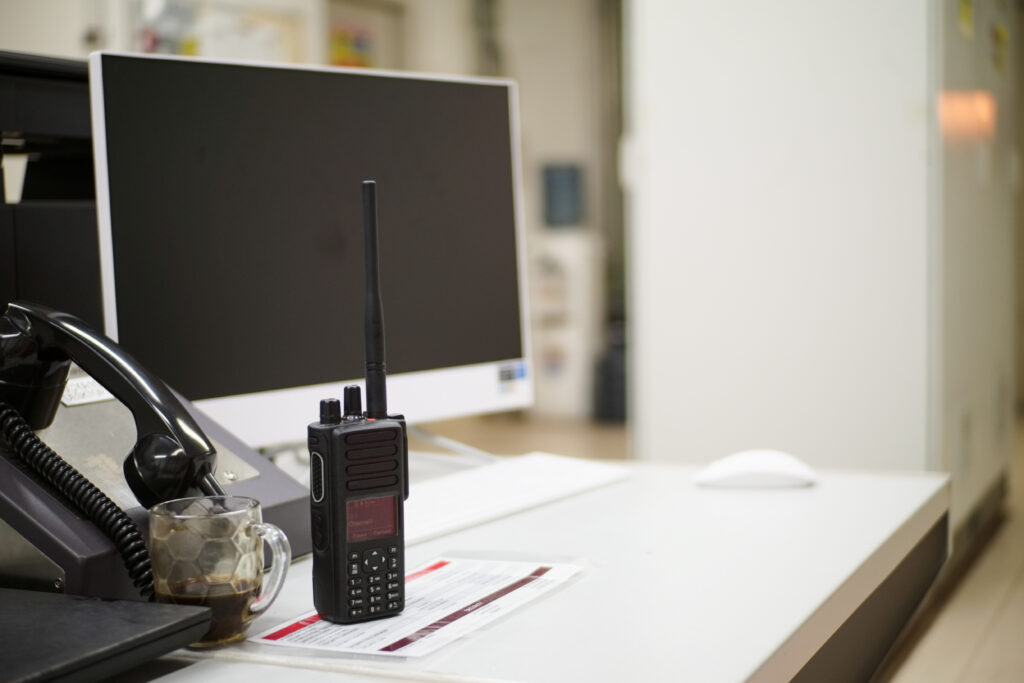
When someone in our service area dials or texts 988, their call is answered by Volunteers of America (VOA) or 988 call specialists who follow a structured protocol to triage and assess the level of care needed. Some crises can be resolved in that first conversation, and when that’s the case, VOA and 988 specialists work directly with the individual to help them through their difficult moment.
When the situation calls for more, the call is forwarded to Comprehensive Healthcare’s Designated Crisis Responder (DCR) offices, where Mental Health Associates, Case Managers, and DCRs are available to respond 24 hours a day.
The result is a layered, around-the-clock system designed to meet each person at exactly the level of response their situation requires – from a supportive phone conversation to a full in-person crisis response.
Barriers like transportation, stigma, distrust of institutions, or simply not knowing where to turn can keep someone from ever making an appointment
Into the Community: Crisis Outreach Across Our Service Area
Comprehensive Healthcare’s acute care service teams don’t wait for people to find us. Across our service area, crisis outreach professionals are embedded in communities — partnering with law enforcement, schools, primary care providers, and other community organizations to reach people where they are and when they need it most.
This community-based model recognizes a simple truth: the people who most need behavioral health support are often the least able to navigate a traditional system to get it. Barriers like transportation, stigma, distrust of institutions, or simply not knowing where to turn can keep someone from ever making an appointment. Our outreach teams are designed to remove those barriers entirely — by going to the person rather than waiting for the person to come to us.
Two programs offer a window into what that work looks like on the ground.
The Field Response Team: A Different Kind of First Responder
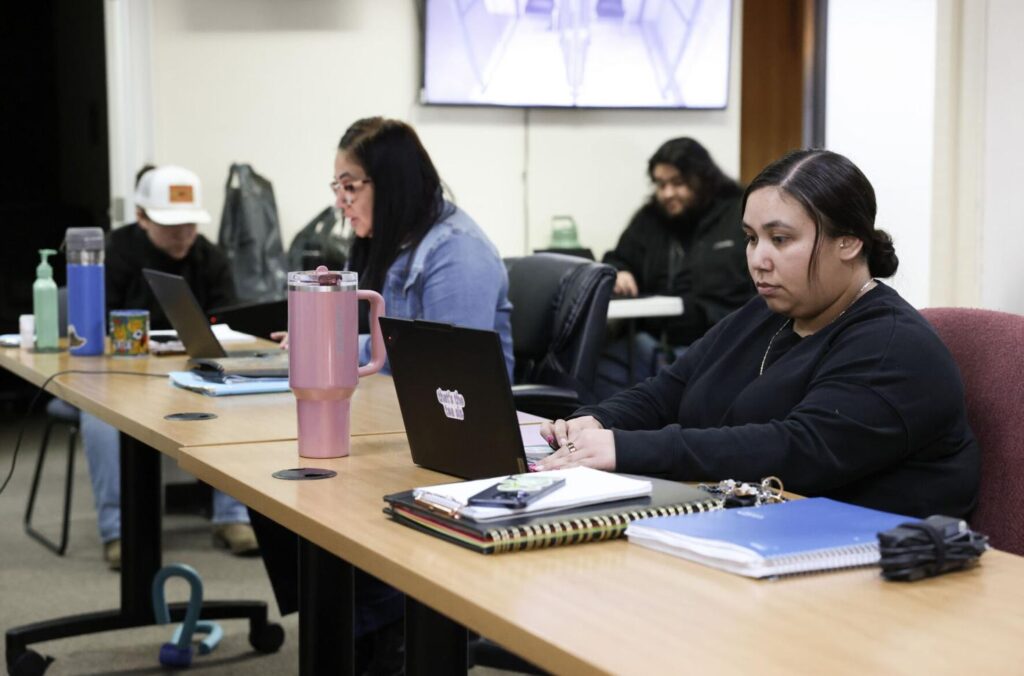
Field Response Team at the Yakima County Sherriff’s Office
When someone in Yakima County calls 911 in the middle of a mental health or substance use crisis, the response looks different than it used to.
Since launching in November 2024, Comprehensive Healthcare’s Field Response Team has embedded behavioral health professionals directly alongside law enforcement across Yakima Valley. The team – made up of four designated crisis responders (DCRs), eight case managers, and five peer support specialists – is stationed at the Yakima County Sherriff’s Office and the Sunnyside Police Department, and is available from 8 a.m. to 11:30 p.m. every day.
Rather than sending only a law enforcement officer to a behavioral health call, the community now has a team specifically trained to de-escalate, assess, and connect – with their own fleet of vehicles, allowing them to respond independently when it’s safe to do so.
The results have been significant. In 2025, the Field Response Team provided more than 3,400 services to over 1,200 clients — a 200% increase compared to the previous year, when Comprehensive Healthcare operated a smaller co-response model.
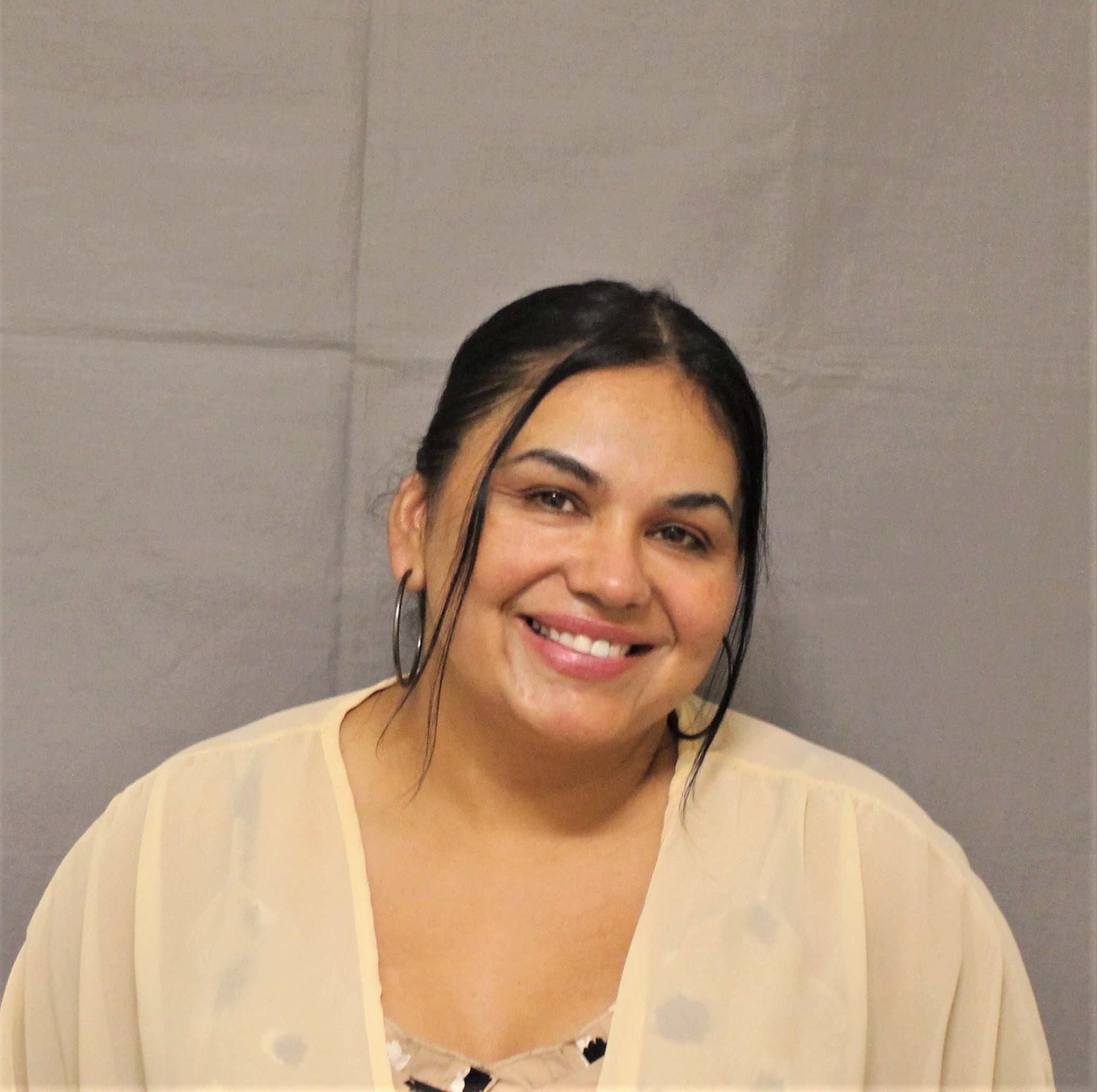
For designated crisis responders like Olga Romo, the work often extends well beyond a single call. Romo recalled a shift where she spent nearly eight hours sitting with someone who had been involuntarily hospitalized, coordinating with medical staff and working to secure a psychiatric placement. The next morning, she was back at her desk by 8 a.m., picking up where she left off. “For me, it’s whatever time is required,” Romo said. “You know, it’s worth it.”
For many of the individuals our field team encounters, that initial contact is the first time anyone in a professional capacity has simply listened to them without an agenda. And often, it’s that moment of being heard that makes the next step possible — whether that’s a warm handoff to outpatient services, a connection to housing resources, or a ride to one of our facilities offering a higher level of care, like the Crisis Stabilization Center.
Youth Mobile Outreach
The Youth Mobile Outreach program serves young people experiencing a crisis that is urgent, but may not meet the threshold for a higher level of care. That might mean mental health challenges, behavioral issues, substance use, or family instability. In the past, these young people often fell through the cracks — unable to qualify for more intensive services, but too close to the edge to be left without support. Now, Comprehensive Healthcare’s outreach teams meet them in the community, building the kind of connection that can change the entire trajectory of what comes next.
Most families are connected to the program through the 988 crisis line, local schools, or primary care physicians. From there, the team conducts an assessment and, when it’s a good fit, begins what is typically an eight-week engagement – through the timeline is always shaped by each family’s needs.
The program is covered through Medicaid or private insurance for most families, and for those without coverage, Comprehensive Healthcare works to eliminate cost as a barrier entirely.
Camp Hope
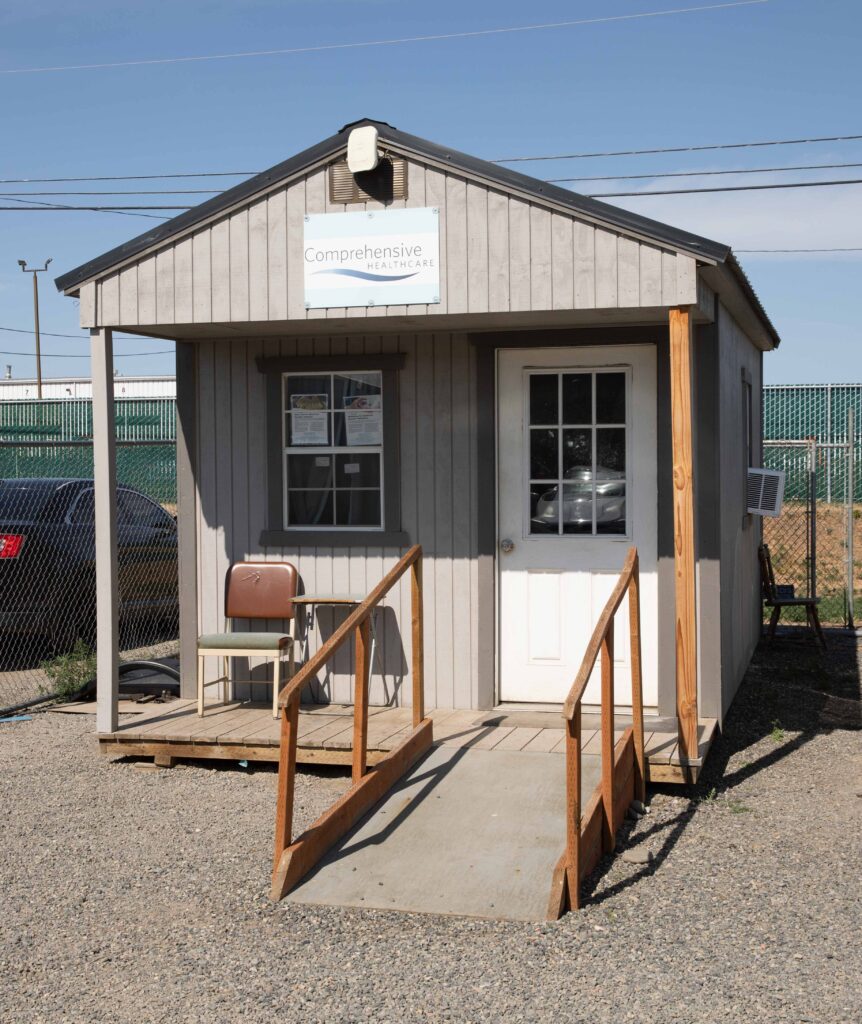
Comprehensive Healthcare’s current facility at Camp Hope
For residents of Camp Hope, Yakima’s sanctioned homeless encampment, accessing behavioral healthcare isn’t always as simple as making an appointment. Transportation, distrust, the weight of daily survival – any one of these can stand between a person and the help they need. So, rather than waiting for Camp Hope residents to find their way to us, Comprehensive Healthcare brings care directly to them.
Nearly every weekday, a team that includes medical providers, peer support counselors, care coordinators, and other staff makes the trip out to Camp Hope to engage with residents on their own turf. The visits aren’t transactional – staff aren’t simply dropping off resources and leaving. They’re building relationships, conducting health screenings, supporting residents in navigating benefits and services, and walking alongside people at one of the most vulnerable points in their lives.
In FY2025, the team served 195 residents and provided 748 services — including peer support, outreach and engagement, office visits, community support, and primary care. Each number represents not just a visit, but a relationship built, a barrier removed, and a door opened.
For many residents, this consistent, unhurried presence is the first step toward something more. A conversation with a peer support counselor can lead to a first therapy appointment. A care coordinator helping someone navigate Medicaid enrollment can open the door to treatment that was previously out of reach. The trust built at a picnic table at Camp Hope can carry someone all the way into our clinics, our housing programs, and beyond.
The Mobile Unit
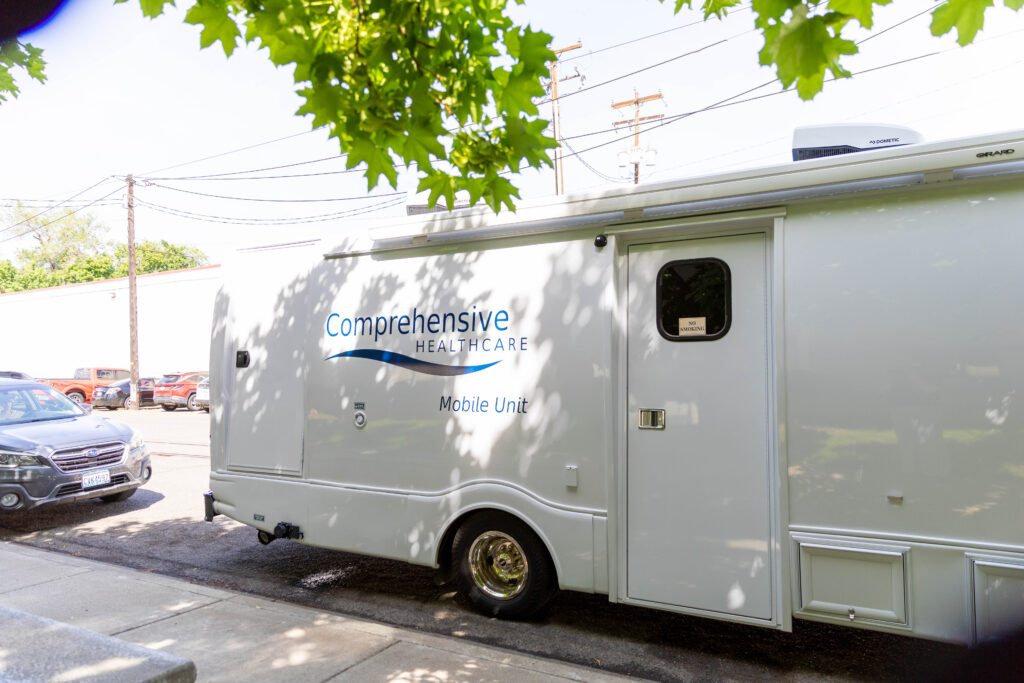
Comprehensive Healthcare’s Mobile Unit
For someone in recovery from opioid use disorder, treatment can mean a daily dose of medication. Until recently, for residents of Kittitas County, it also meant a daily hour-long drive. Methadone, one of the most effective medications for opioid use disorder, can only be dispensed through a certified Opioid Treatment Program, and the nearest was Comprehensive Healthcare’s program in Yakima. For people already navigating the demands of early recovery, that distance went beyond an inconvenience. Research consistently shows that the farther someone lives from treatment, the less likely they are to receive it at all.
Comprehensive Healthcare’s Mobile Unit was built to bridge that gap. Operating in Ellensburg six days a week, the unit brings medication-assisted treatment directly to the community – offering provider visits, counseling, methadone and buprenorphine dosing, and connections to other local services.
One Organization, Many Points of Entry
The Field Response Team, Youth Mobile Outreach, and Camp Hope are three expressions of something larger – an organizational commitment to meeting people where they are, across every corner of our service area. From the moment someone dials 988 to the outreach worker who shows up at a school or a doorstep, Comprehensive Healthcare is working to ensure that the distance between a person in need and the help they deserve is as small as possible.
This is what a true continuum of care looks like. Not a single front door, but many points of entry – each one staffed by people who believe that showing up is the first and most important act of care.
In crisis? Call or text 988 to reach the Suicide and Crisis Lifeline. To learn more about Comprehensive Healthcare’s crisis and outreach services, visit comphc.org.